Let’s unpack this clearly — both what Max Drawdown % means, and why it often signals that “the backtesting game is over.”
💡 What is Max Drawdown (%)?
Max Drawdown (MDD) is a key risk metric that measures the largest peak-to-trough decline in your portfolio or strategy equity curve during a given period, expressed as a percentage.
Formally:
🔍 Example
Suppose your backtested strategy’s equity curve goes:
| Time | Portfolio Value |
|---|---|
| Jan | $100,000 |
| Mar | $130,000 ← Peak |
| Jun | $85,000 ← Trough |
| Sep | $140,000 |
Then:
This means at one point, your account dropped 34.6% from its high before recovering.
⚠️ Why It Matters
-
Drawdown = Pain. A big drawdown means real psychological and financial stress.
Most traders (or investors) quit or get liquidated long before recovery. -
It defines risk tolerance. You can survive a 10% drawdown.
You might survive 25%.
You probably won’t survive 60%. -
It’s about time, not just loss. Recovery from large drawdowns gets disproportionately harder: the gain needed is D ÷ (1 − D), which rises steeply as the drawdown deepens.
Drawdown Gain Needed to Recover 10% +11.1% 20% +25% 50% +100% 80% +400%
🎮 “The Backtesting Game is Over” — What That Means
In ForexThrive, a backtesting game literally ends when your equity falls through the account’s maximum drawdown limit. More broadly, when traders say “the backtesting game is over”, they mean that your backtest no longer matters because your strategy’s Max Drawdown is too large to be realistic or survivable in live conditions.
Reasons why:
-
Overfitting reality:
Your backtest might look great until one period crushes it. A huge drawdown shows your strategy wasn’t robust — it just worked on past noise. -
Unrealistic assumptions:
Backtests often assume perfect execution, no slippage, infinite liquidity, and no emotions — which hide drawdown risk. -
Capital destruction:
Once you hit catastrophic drawdowns (>30–40%), compounding works against you: a 30% loss needs +43% and a 40% loss needs +67% just to get back to the peak.
You’re no longer in a position to recover — the “game” (simulation or real capital) is effectively over. -
Psychological and funding limits:
Even if a backtest recovers, you or your investors probably wouldn’t sit through a 50%+ drawdown.
So the system, in practice, is dead.
🧭 Takeaway
Max Drawdown % isn’t just a number — it’s a survival threshold.
When it gets too large, it tells you:
“This strategy may have been profitable in a spreadsheet, but it wouldn’t survive the real market.”
That’s why when you see an equity curve collapse and Max Drawdown spikes,
👉 the backtesting game is over.
📐 Calculating Max Drawdown from an Equity Curve
The formula uses the highest peak before the trough, not simply the highest and lowest values in the whole period. In practice:
- Walk through the equity curve in time order and keep a running peak (the highest equity so far).
- At each point, calculate the drawdown: (running peak − current equity) ÷ running peak.
- The largest drawdown you record is the max drawdown.
In the example above, the running peak is $130,000 in March and the lowest point after it is $85,000 in June, so MDD = 34.6%. The new high of $140,000 in September resets the running peak but doesn't change the MDD, because no deeper fall follows it. A low that comes before a peak is never part of a drawdown.
Also measure drawdown on equity (including open trades' floating losses), not just on closed-trade balance. A position that dips 15% before recovering to a small win never shows in the balance, but you still had to sit through it.
🎮 Max Drawdown in the ForexThrive Simulator
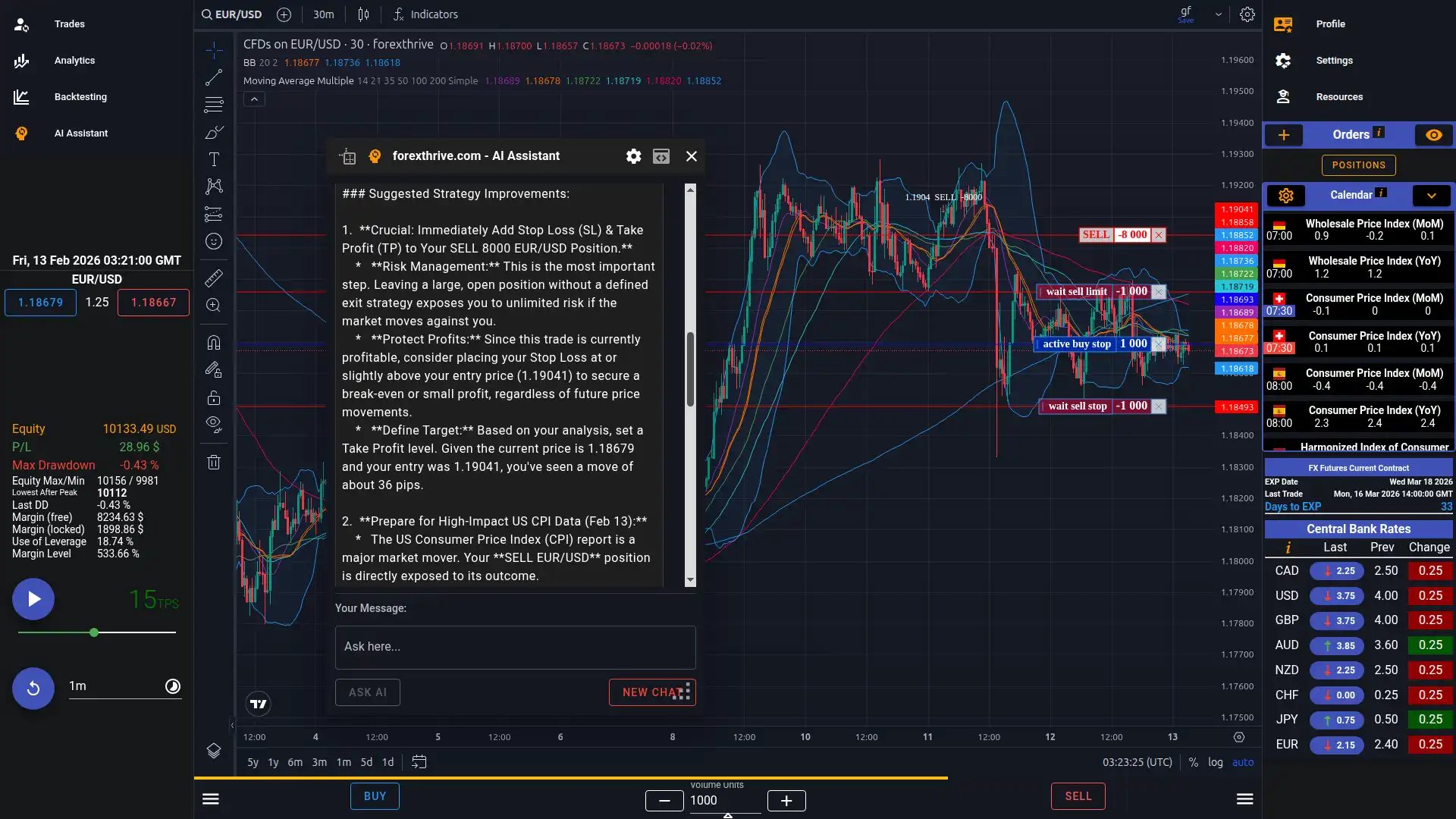
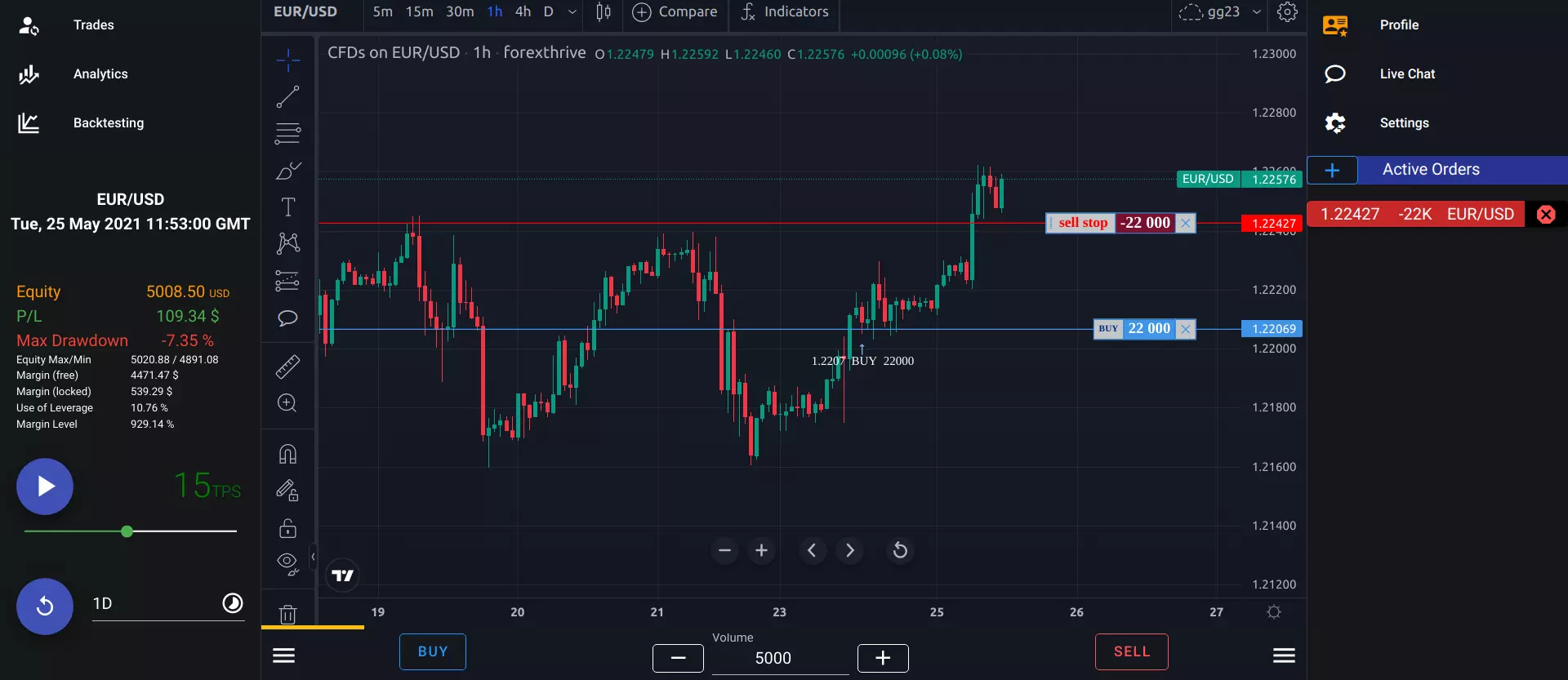
In the ForexThrive simulator, every game has a maximum drawdown limit, and the game ends when equity falls through it. On the free plan the limit is fixed at 10%. On a prepaid plan you can set your own. Your current drawdown is shown in the left-hand menu next to your account balance. Choosing the limit before you start makes the game a direct test of whether a strategy stays within the drawdown you could actually tolerate live.
Frequently asked questions
How do you calculate max drawdown?
Track the running peak of your equity curve. At each point, divide the drop from that running peak by the peak. The largest value is the max drawdown. In the example, the $130,000 peak falls to an $85,000 trough, so (130,000 − 85,000) ÷ 130,000 = 34.6%.
How much gain do I need to recover from a drawdown?
The required gain is D ÷ (1 − D), where D is the drawdown as a decimal. A 10% drawdown needs +11.1%, 20% needs +25%, 50% needs +100% and 80% needs +400%. The gain needed grows much faster than the loss itself.
What is a good max drawdown for a strategy?
It depends on your risk tolerance and capital. As this guide notes, most traders can live with around 10%, may survive 25%, and rarely survive 60%. Set a maximum drawdown limit before testing and reject strategies whose backtests exceed it.
What happens when I hit max drawdown in ForexThrive?
The game ends. On the free plan the maximum drawdown is fixed at 10% of equity. Prepaid plans let you set your own limit. Your current drawdown is always shown in the left-hand menu next to your account balance, so you can see how close you are.