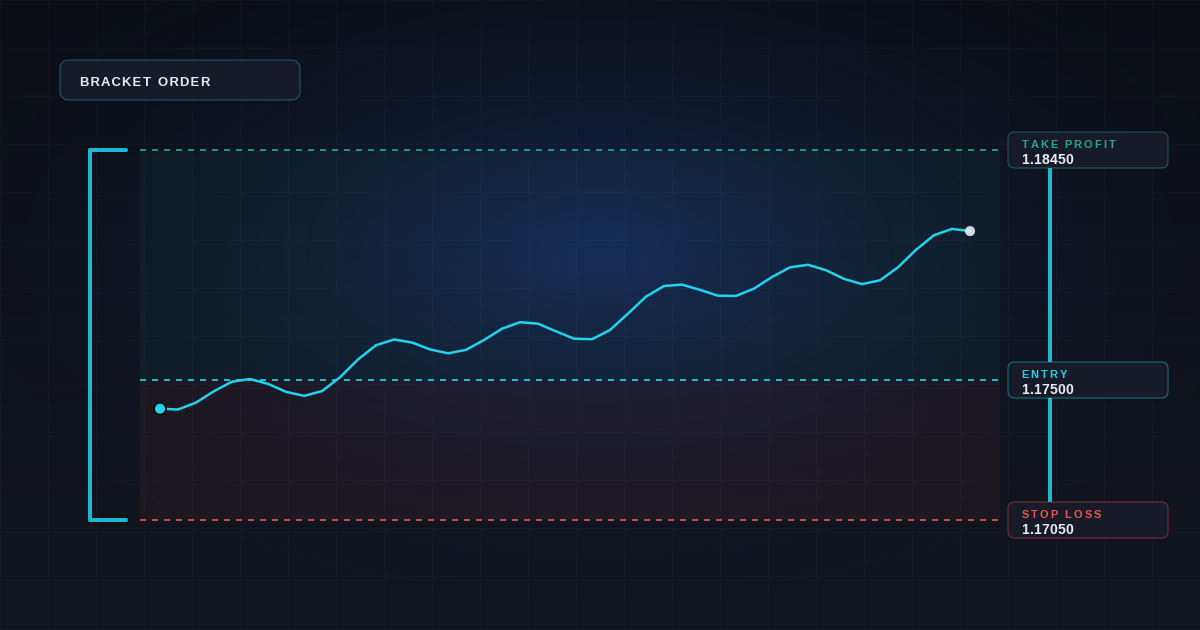
Thinking in dollars is useful because it is the number that actually leaves or enters your account. This guide covers the conversion, how reward-to-risk follows from the two amounts, the win rate each ratio needs, and how to place the order with both levels attached.
The conversion: dollars to price distance
For any pair quoted in US dollars, such as EUR/USD or GBP/USD, a position gains or loses one dollar per unit for every 1.0000 the price moves. So:
- Price distance = dollars ÷ units. $6 ÷ 1,000 units = 0.0060, which is 60 pips.
- Stop price (long trade) = entry − distance. From an entry at 1.33918, the stop is 1.33318.
- Target price (long trade) = entry + distance. $10 ÷ 1,000 = 0.0100, so the target is 1.34918.
For a short trade the signs flip: the stop goes above the entry and the target below it.
| Position size | Value of 1 pip (USD-quoted pairs) | A $50 stop is |
|---|---|---|
| 1,000 units (micro lot) | $0.10 | 500 pips |
| 10,000 units (mini lot) | $1 | 50 pips |
| 100,000 units (standard lot) | $10 | 5 pips |
Pairs that are not quoted in dollars need one more step. On USD/JPY a pip is 0.01 and is worth yen, so you divide by the current price to get dollars. The position size calculator does this for major pairs, crosses, gold and crypto.
Two ways to get there
Fix the dollars and the size, and accept the distance
This is the method above: you choose the trade size and the dollar amounts, and the stop lands wherever the arithmetic puts it. It is simple, but the stop may sit at a price that means nothing on the chart, in the middle of normal market noise.
Fix the dollars and the distance, and calculate the size
This is the method most experienced traders use. You place the stop where the trade idea is proven wrong, for example just beyond the last swing low, and measure that distance in pips. Then you size the position so that distance costs exactly the dollars you chose:
- Units = dollars at risk ÷ stop distance. Risking $50 with a 25-pip stop on EUR/USD is $50 ÷ 0.0025 = 20,000 units, or 0.20 lots.
The dollar risk is identical in both methods. The difference is that the second one lets the chart decide where the stop goes.
Reward-to-risk and the win rate it needs
The reward-to-risk ratio is the take profit amount divided by the stop loss amount. A $10 target against a $6 stop is 10 ÷ 6 = 1.67. The ratio tells you how often you must win to break even:
- Break-even win rate = 1 ÷ (1 + reward-to-risk).
| Reward-to-risk | Break-even win rate (before costs) |
|---|---|
| 1 | 50.0% |
| 1.5 | 40.0% |
| 1.67 | 37.5% |
| 2 | 33.3% |
| 3 | 25.0% |
A higher ratio needs fewer wins, but a distant target is also reached less often. Neither number means much alone: a strategy is profitable when its real win rate is above the break-even rate for its real ratio. The only way to know both is to test, which is what a manual backtest gives you.
Costs shift the numbers against you. Spread and commission make every loss slightly larger and every win slightly smaller, so the true break-even win rate is a little higher than the table shows. The effect is biggest on small stops: a 1-pip spread is 10% of a 10-pip stop but only 1% of a 100-pip stop.
Placing the order in ForexThrive
The ForexThrive order form takes the two amounts in dollars and shows the resulting prices and ratio before you place anything:
- Open the order form. Use the plus button in the Orders panel. The entry price starts at the current market price; change it if you want a pending order at another level.
- Set the size. Enter the volume in units, for example 1,000.
- Switch on T/P and S/L. Two amount fields appear: Take Profit Sum and Stop Loss Sum.
- Enter the take profit amount. For example 10. The form shows the target price, 1.34918 for an entry at 1.33918.
- Enter the stop loss amount as a negative number. It is a loss, so type -6, not 6. The form shows the stop price, 1.33318. If the stop price appears on the wrong side of your entry, check the sign.
- Read the summary. The form shows the reward-to-risk ratio (1.67 here) and each amount as a percentage of your account.
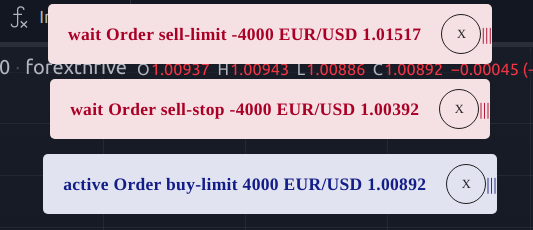
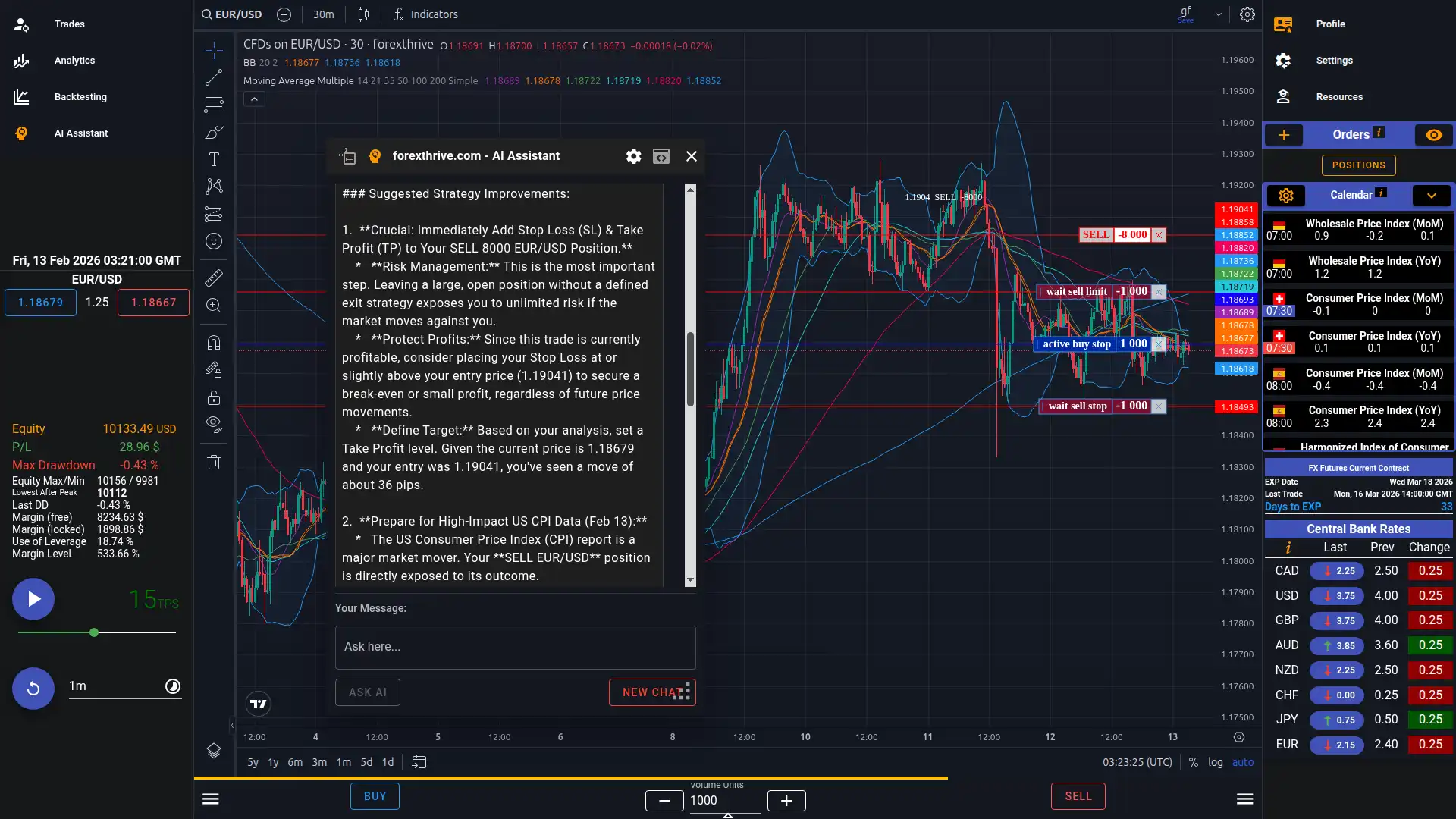
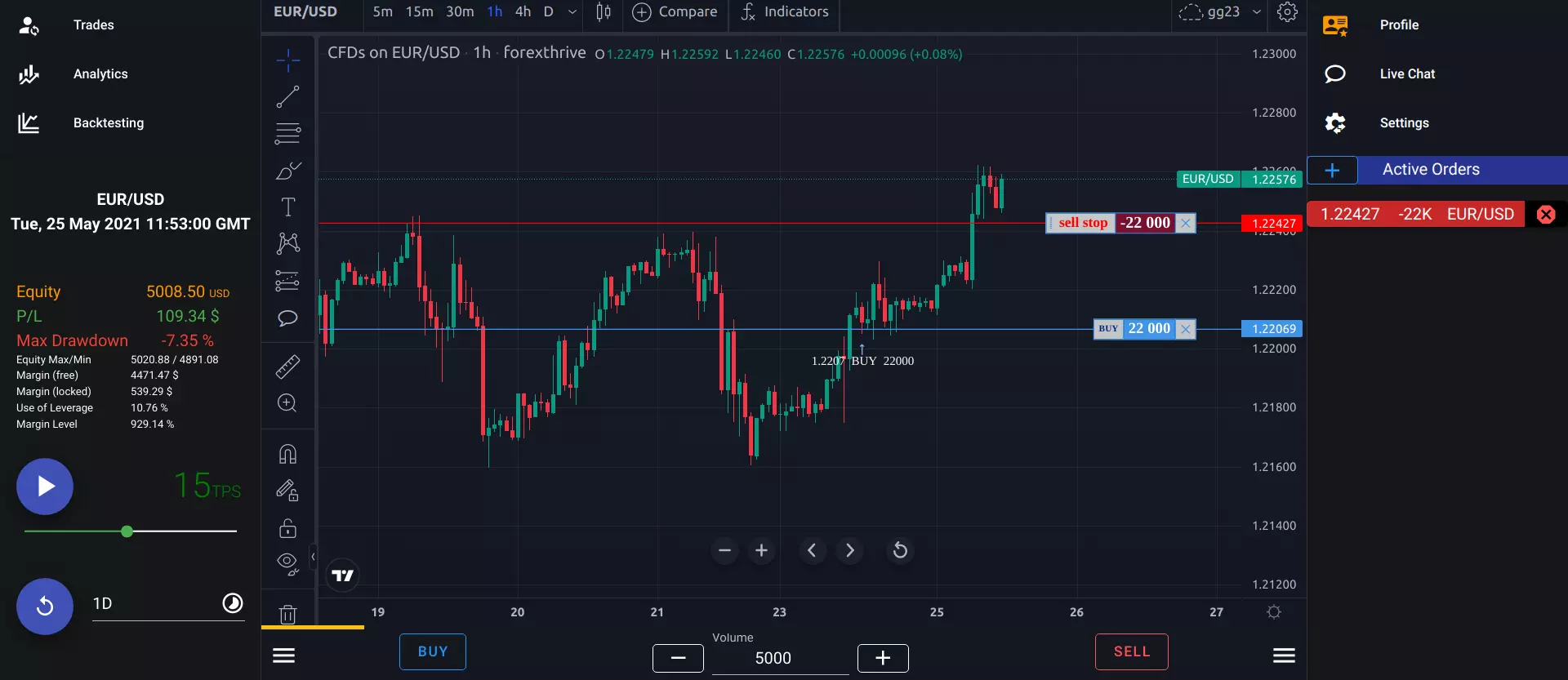
- Press Buy or Sell. The entry is placed with two attached orders, one at the target and one at the stop. Both appear as lines on the chart, and when one of them fills the other is cancelled.
This kind of order is called a bracket. For more on how the attached orders behave, see how to use bracket orders. If you already hold a position in the same instrument, the new trade is added to it and the position shows the combined size.
Common mistakes
- Choosing the stop by dollars alone. A stop that fits your budget but sits inside normal price noise will be hit by trades that were right.
- Moving the stop further away once the trade is losing. The dollar amount you planned stops being the amount you lose.
- Chasing a high ratio. A 5-to-1 target looks good on paper and is rarely reached. Use the ratio your backtest supports.
- Ignoring the spread. A buy order is filled at the ask and closed at the bid, so the trade starts slightly negative and the stop is closer than it looks.
- Risking a different amount on every trade. Results become impossible to compare. Risk a fixed percentage of the account each time.
If you trade under prop firm rules, the dollar amount per trade matters even more. See how much to risk per trade in a prop firm challenge for pass rates at different risk levels.
Frequently asked questions
How do I convert a dollar stop loss into pips?
Divide the dollar amount by the pip value of your position. On pairs quoted in US dollars, one pip is worth $0.10 per 1,000 units, $1 per 10,000 units and $10 per 100,000 units. A $50 stop on 10,000 units is therefore 50 pips.
What is a good risk-reward ratio?
There is no single good ratio. What matters is the ratio together with your win rate: at 1.5 you need to win more than 40% of trades to profit before costs, and at 2 you need more than 33.3%. Many traders work between 1.5 and 3, but only testing shows which ratio your strategy actually achieves.
Should I set my stop loss in dollars or in pips?
Decide the risk in dollars, or as a percentage of your account, and place the stop in pips where the trade idea is proven wrong. Then calculate the position size that makes that pip distance equal to your dollar risk. That way both the budget and the chart are respected.
Why is the stop loss amount negative in the order form?
Because it is the result of the trade if the stop is hit, and that result is a loss. A take profit of 10 means the trade closes at plus $10, and a stop loss of −6 means it closes at minus $6. Entering a positive stop amount places the stop on the profit side of the entry.
Does the reward-to-risk ratio include the spread?
Not unless you include it. The ratio from your planned prices ignores costs. Spread and commission reduce each win and add to each loss, so the ratio you actually receive is slightly lower, especially with small stops.