Quick comparison
| Method | Data used | Speed | What it tests | Main weakness |
|---|---|---|---|---|
| Backtesting | Historical prices | Fast: months or years of data in hours or days | Whether the rules had an edge in the past | Overfitting and look-ahead bias can make results look better than they are |
| Forward testing | New, unseen data, in real time or replayed as if live | Slow: runs at the pace of the market | Whether the edge holds on data the strategy was not built on | Takes weeks or months to collect enough trades |
| Paper trading | Live prices on a demo or simulated account | Slow: real time only | Your execution, routine and platform handling | No real money, so no real emotions; fills are often better than live |
What is backtesting?
Backtesting means applying a set of trading rules to historical price data and recording what would have happened. You get a list of trades, and from that list you can measure win rate, average win and loss, expectancy and drawdown.
There are two main ways to do it:
- Manual backtesting. You scroll or replay a chart bar by bar, decide on each trade as if it were live, and log the result. It is slower, but works well for discretionary strategies that are hard to code.
- Automated backtesting. You write the rules as code and a program runs them across years of data in seconds. It is fast and consistent, but only works for rules that can be defined exactly.
Backtesting is the cheapest way to reject a bad idea. Most strategies fail here, and that is useful: it costs you time, not money. But a good backtest does not prove a strategy works. Two pitfalls cause most false confidence:
- Overfitting (curve fitting). If you keep adjusting settings until the past looks perfect, you end up fitting the noise in that specific data, not a real pattern. The strategy looks great on the test period and fails on anything new.
- Look-ahead bias. This happens when the test uses information that was not available at the time of the trade. Common examples are entering on a candle's close while treating its high or low as already known, or using an indicator value that repaints later. In manual testing, simply seeing the chart to the right of your entry can bias your decisions.
Data selection matters too. Testing only on a period or market that you already know worked is a form of survivorship bias, and it inflates results in the same way.
What is forward testing?
Forward testing, sometimes called out-of-sample testing or walk-forward testing, means running a strategy with its rules frozen on data it was not designed or tuned on. The key idea is that the data is new to the strategy. It can be live market data as it arrives, or a period of history you deliberately kept aside and never looked at while building the rules.
Forward testing catches overfitting because an overfitted strategy has learned the quirks of one data set. When it meets fresh data, those quirks are not there, and performance drops sharply. A strategy with a real edge usually performs somewhat worse forward than in the backtest, but in a similar range. If the results collapse, the backtest was probably telling you more about your tuning than about the market.
Forward testing in real time also shows things a fast backtest hides: how often setups actually appear, how long you wait between trades, and whether you can follow the rules during normal working hours.
What is paper trading?
Paper trading means placing simulated trades on live prices without real money, usually on a broker's demo account.
Paper trading and forward testing overlap a lot. If you paper trade a strategy with fixed rules and log every trade, you are forward testing it. The difference is mainly in purpose: forward testing is about checking the strategy, while paper trading is often used to learn a platform, practise order entry, or build a routine.
Paper trading has clear limits:
- Emotions. Losing demo money does not feel like losing real money. Traders often follow rules well on demo and then hesitate, move stops or close winners early once real money is at risk.
- Fills and costs. Demo accounts may fill orders instantly at the quoted price. Live trading can involve slippage, wider spreads during news, and partial fills, especially in fast markets.
- Speed. It runs only in real time, so building a meaningful sample can take months.
How to use all three in sequence
These methods are not rivals. They are steps, and each one filters out problems the previous step could not see. A practical workflow looks like this:
- Write the rules down. Define entries, exits, stop loss, position size and which markets and sessions you trade. If a rule is vague, you cannot test it. Our guide to trading strategy development covers this step in detail.
- Split your data. Choose a development period for building and adjusting the strategy, and keep a separate later period untouched for out-of-sample checking.
- Backtest on the development period. As a rule of thumb, aim for at least 30 trades before reading anything into the results, and 100 or more before trusting them. Include realistic spread, commission and swap costs. Track maximum drawdown, not just profit.
- Test on the untouched period. Run the frozen rules on the held-out data. Do not tweak anything. If results are far worse, go back to step 1 rather than adjusting until it passes.
- Forward test on live or live-like data. Run the strategy in real time for another sample, again ideally 30 to 100 trades or several weeks at minimum, depending on how often it trades.
- Go live small. Start with the smallest position size your broker allows. This step tests your psychology and real fills, which no simulation fully captures.
These numbers are guidelines, not guarantees. Fewer trades means more of the result could be luck. A strategy that trades rarely needs a longer test period to reach the same sample size.
How to do this in ForexThrive
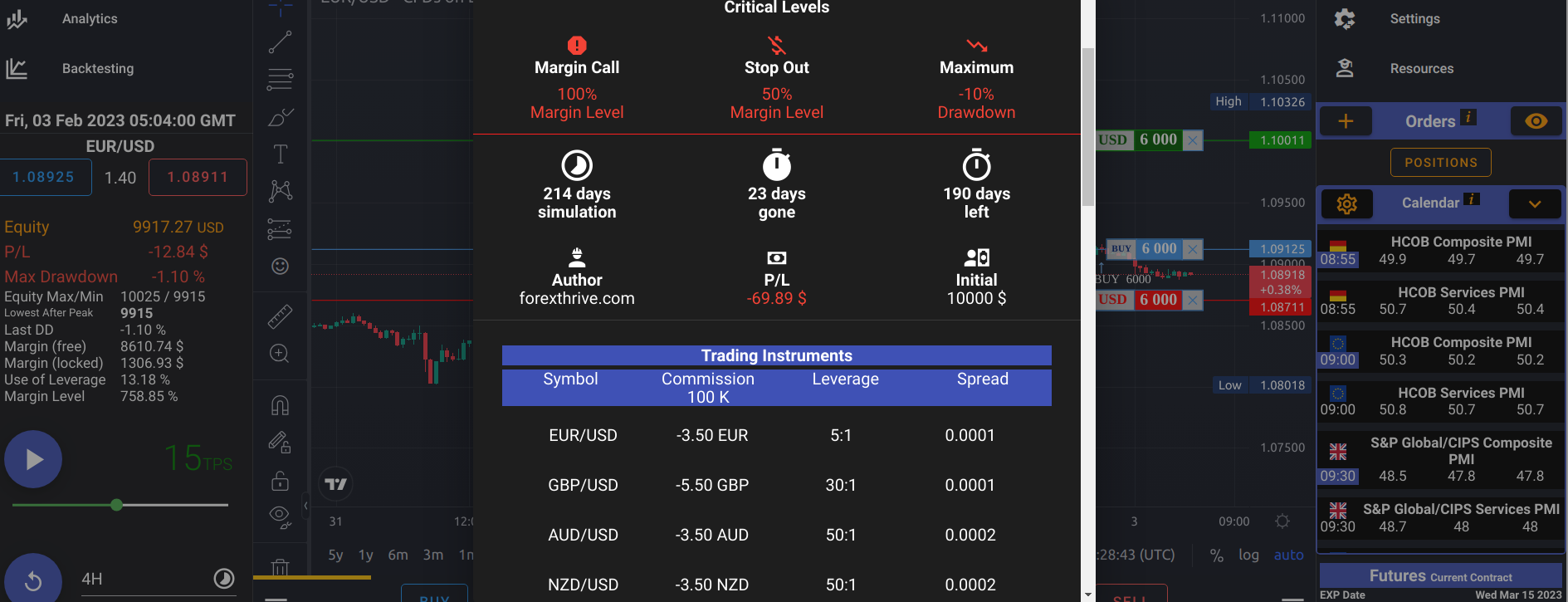
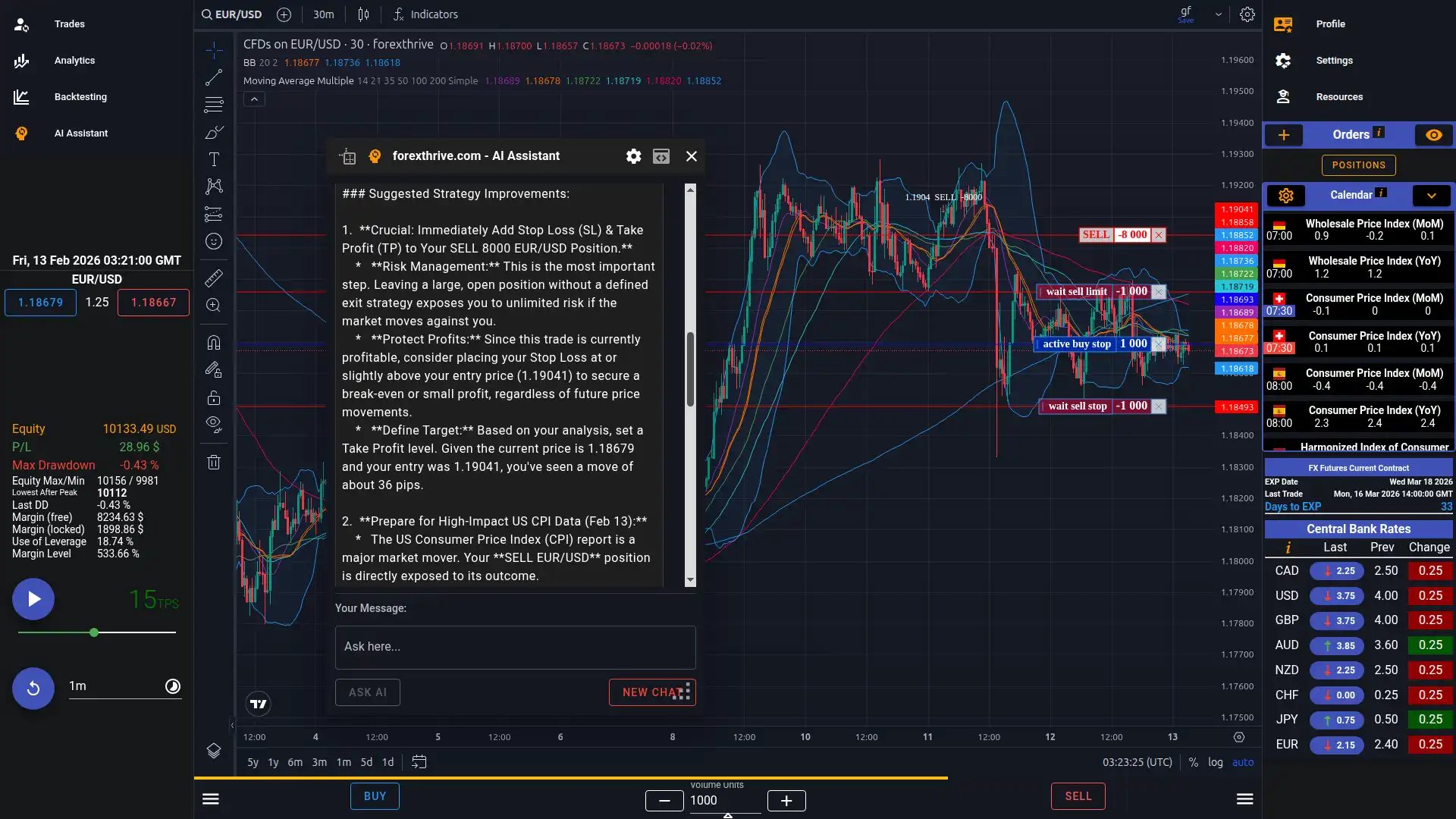
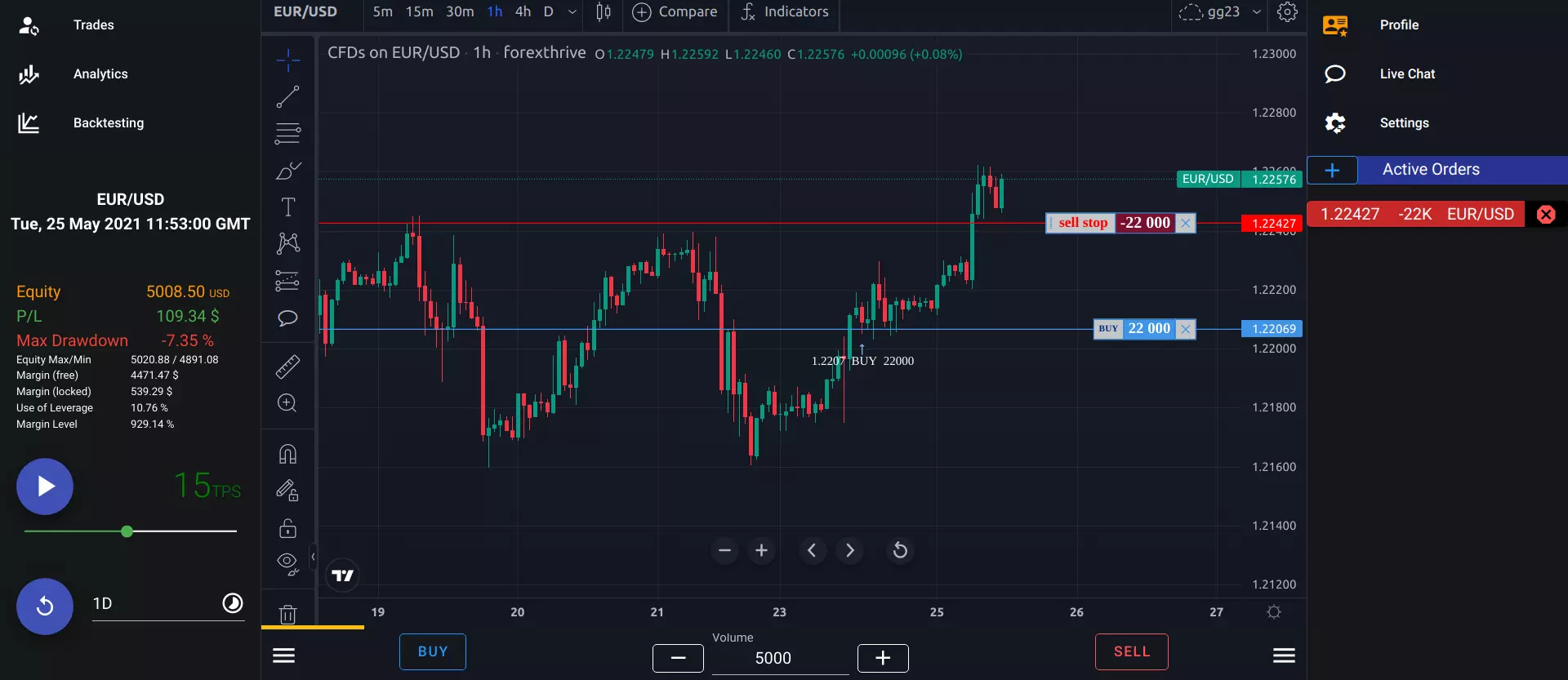
ForexThrive is a browser-based forex replay and backtesting simulator that also works on phones. You trade historical 1-minute OHLC bars (not tick data) as they replay, with spread, commission and overnight swap applied, and a game ends if you hit its maximum drawdown limit.
On a prepaid plan you can create up to 5 games on any dates back to 2006, and a game can end up to one year in the future. When the replay reaches the present day, the same session switches to 1-minute-delayed live data. That means your backtest turns into a forward test without starting a new account or a new trade log: one continuous record. The replay engine only advances while the app is open, and any time you spend away is replayed when you return, never skipped. Prepaid plans cost the equivalent of $8 to $23 per month and never auto-renew.
If you only want to practise backtesting first, the free plan gives you one predefined game from 22 February to 23 May 2022 with the full replay engine.
Common mistakes
- Treating a great backtest as proof. A backtest is a hypothesis until it survives unseen data.
- Changing rules during a forward test. Every change resets the test. Log ideas and apply them to a new test later.
- Stopping too early. Ten trades tell you very little. Wait for a reasonable sample before deciding either way.
- Ignoring costs. Spread, commission and swap can turn a small edge into a loss, especially on short timeframes.
- Testing only one market condition. A strategy tested only in a strong trend may fail in a range. Include different conditions where possible.
- Skipping the small live step. Going straight from demo to full size removes your chance to learn how you handle real risk.
Frequently asked questions
Is paper trading the same as forward testing?
They overlap. Paper trading a strategy with fixed rules and a full trade log is a form of forward testing. But paper trading is also used just to practise a platform or order entry without testing any particular strategy. Forward testing is defined by using new, unseen data with frozen rules, whether live or held back from history.
What is forward testing in trading?
Forward testing means running a strategy, with its rules already fixed, on data it was not built or tuned on. This is usually live market data as it arrives, or a period of history kept aside. It shows whether the results from a backtest hold up on new data or were the product of overfitting.
Which is better, backtesting or forward testing?
Neither replaces the other. Backtesting is fast and good for rejecting weak ideas early. Forward testing is slower but checks whether the edge survives on unseen data. Most traders use backtesting first to filter ideas, then forward testing to confirm the few that pass, before risking real money with small positions.
How many trades do I need for a reliable backtest?
There is no exact number, but a common rule of thumb is at least 30 trades before drawing any conclusions and 100 or more before relying on the results. Strategies with a low win rate or large, rare winners usually need even bigger samples, because a few lucky trades can distort the average.
Can I skip forward testing if my backtest is strong?
It is not recommended. Strong backtests are often the result of overfitting or look-ahead bias, and those problems only show up on new data. A forward test with a reasonable sample size, followed by small live trading, is the safest way to find out whether the strategy really works.